The Power of Insight: A Deep Dive into Business Intelligence Software
In today’s data-driven world, the ability to glean meaningful insights from vast quantities of information is no longer a luxury, but a necessity for survival and success. Business Intelligence (BI) software has emerged as a cornerstone technology, empowering organizations to transform raw data into actionable intelligence, enabling smarter decisions, improved performance, and a competitive edge.
What is Business Intelligence Software?
At its core, Business Intelligence software is a suite of applications and technologies designed to collect, analyze, and present data in a way that helps businesses understand their past, present, and potential future performance. It encompasses a wide range of functionalities, including:
- Data Extraction, Transformation, and Loading (ETL): The process of gathering data from diverse sources, cleaning and standardizing it, and loading it into a central repository (data warehouse or data lake).
- Data Warehousing: A centralized storage system that holds integrated data from multiple sources, optimized for analysis and reporting.
- Data Mining: Using algorithms and statistical techniques to uncover hidden patterns, relationships, and anomalies within large datasets.
- Reporting: Creating static or interactive reports that summarize key performance indicators (KPIs) and trends.
- Online Analytical Processing (OLAP): Enabling users to analyze data from multiple dimensions, allowing for drill-down and slicing-and-dicing of information.
- Data Visualization: Presenting data in graphical formats (charts, graphs, maps, dashboards) to make it easier to understand and interpret.
- Dashboards: Real-time visual displays of key metrics and performance indicators, providing a snapshot of the organization’s health.
- Predictive Analytics: Using statistical models and machine learning to forecast future outcomes and trends.
- Text Mining: Extracting insights and sentiment from unstructured text data (customer reviews, social media posts, emails).
Key Benefits of Business Intelligence Software
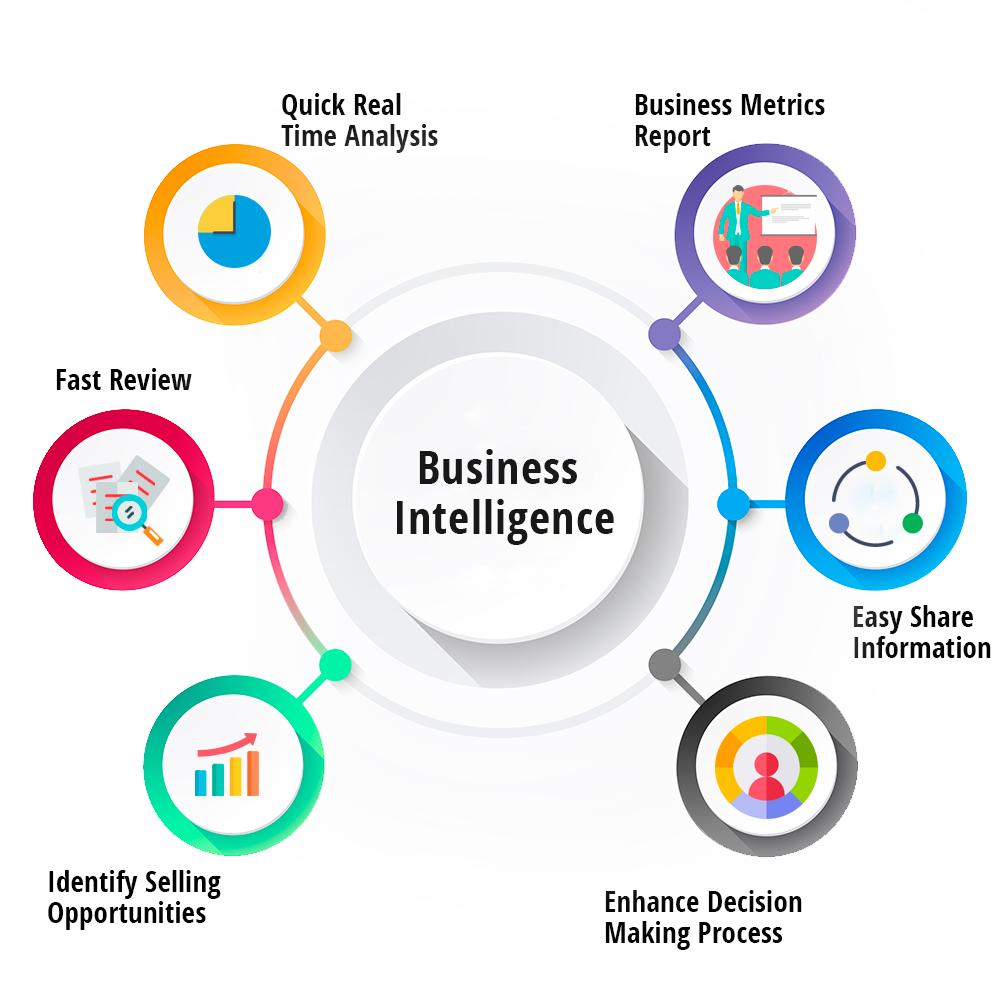
The implementation of BI software can yield a multitude of benefits across various aspects of an organization:
-
Improved Decision-Making: BI provides decision-makers with accurate, timely, and relevant information, enabling them to make informed choices based on facts rather than intuition.
-
Enhanced Operational Efficiency: By identifying bottlenecks, inefficiencies, and areas for improvement, BI helps streamline processes and optimize resource allocation.
-
Increased Revenue and Profitability: BI can uncover opportunities for revenue growth, identify profitable customer segments, and optimize pricing strategies.
-
Better Customer Understanding: Analyzing customer data helps organizations understand customer behavior, preferences, and needs, leading to more targeted marketing campaigns and improved customer satisfaction.
-
Competitive Advantage: BI enables organizations to monitor competitor activities, identify market trends, and respond quickly to changing market conditions.
-
Risk Management: By identifying potential risks and vulnerabilities, BI helps organizations mitigate threats and protect their assets.
-
Performance Monitoring: BI provides real-time insights into key performance indicators (KPIs), allowing organizations to track progress towards goals and identify areas that require attention.
-
Data-Driven Culture: BI fosters a culture of data-driven decision-making, where decisions are based on evidence rather than gut feelings.
Who Uses Business Intelligence Software?
BI software is used by organizations of all sizes and across various industries, including:
- Retail: Analyzing sales data, customer behavior, and inventory levels to optimize merchandising, pricing, and supply chain management.
- Finance: Monitoring financial performance, managing risk, and detecting fraud.
- Healthcare: Improving patient care, optimizing hospital operations, and reducing costs.
- Manufacturing: Optimizing production processes, managing inventory, and improving quality control.
- Marketing: Analyzing campaign performance, identifying target audiences, and personalizing marketing messages.
- Human Resources: Tracking employee performance, managing talent, and improving employee engagement.
- Government: Monitoring public services, managing budgets, and improving citizen engagement.
Types of Business Intelligence Software
BI software can be broadly categorized into the following types:
- Traditional BI: Focuses on structured data, historical reporting, and predefined queries.
- Modern BI: Emphasizes self-service analytics, data discovery, and interactive visualizations.
- Embedded BI: Integrates BI capabilities directly into other applications, such as CRM or ERP systems.
- Mobile BI: Provides access to BI reports and dashboards on mobile devices.
- Cloud BI: Hosted in the cloud, offering scalability, flexibility, and cost-effectiveness.
Key Features to Look for in Business Intelligence Software
When selecting BI software, consider the following key features:
- Data Connectivity: The ability to connect to a wide range of data sources, including databases, spreadsheets, cloud applications, and social media platforms.
- Data Modeling: Tools for creating and managing data models that represent the relationships between different data elements.
- Data Visualization: A variety of charts, graphs, and maps for presenting data in a visually appealing and easy-to-understand manner.
- Self-Service Analytics: The ability for users to explore data and create their own reports and dashboards without requiring technical expertise.
- Mobile Access: The ability to access BI reports and dashboards on mobile devices.
- Collaboration: Features that enable users to share insights and collaborate on data analysis.
- Security: Robust security features to protect sensitive data.
- Scalability: The ability to scale the software to accommodate growing data volumes and user populations.
- Integration: The ability to integrate with other business applications, such as CRM and ERP systems.
Popular Business Intelligence Software Vendors
The BI software market is crowded with vendors, each offering a unique set of features and capabilities. Some of the leading vendors include:
- Microsoft Power BI: A cloud-based BI platform that offers a wide range of features, including data visualization, self-service analytics, and mobile access.
- Tableau: A data visualization tool that allows users to create interactive dashboards and reports.
- Qlik: A BI platform that uses associative technology to allow users to explore data in a non-linear way.
- SAP BusinessObjects: A comprehensive BI suite that includes reporting, analytics, and data warehousing capabilities.
- Oracle Business Intelligence: A BI platform that offers a wide range of features, including data visualization, self-service analytics, and predictive analytics.
- Sisense: An end-to-end BI platform, well known for its capacity to manage and analyze complex data sets.
- ThoughtSpot: A BI platform focusing on search-driven analytics.
Challenges of Implementing Business Intelligence Software
While BI software offers significant benefits, there are also challenges associated with its implementation:
- Data Quality: Poor data quality can lead to inaccurate insights and flawed decisions.
- Data Integration: Integrating data from diverse sources can be complex and time-consuming.
- User Adoption: Getting users to adopt and use BI software can be challenging, especially if they are not familiar with data analysis.
- Cost: BI software can be expensive, especially for small businesses.
- Skills Gap: Implementing and maintaining BI software requires specialized skills, which may be difficult to find.
Best Practices for Implementing Business Intelligence Software
To maximize the success of a BI implementation, consider the following best practices:
- Define Clear Goals: Clearly define the goals and objectives of the BI implementation.
- Involve Stakeholders: Involve stakeholders from across the organization in the planning and implementation process.
- Ensure Data Quality: Implement data quality processes to ensure that data is accurate, complete, and consistent.
- Provide Training: Provide users with adequate training on how to use the BI software.
- Start Small: Start with a small pilot project to test the software and refine the implementation approach.
- Iterate and Improve: Continuously iterate and improve the BI implementation based on user feedback and changing business needs.
The Future of Business Intelligence Software
The future of BI software is likely to be shaped by the following trends:
- Artificial Intelligence (AI) and Machine Learning (ML): AI and ML will be increasingly integrated into BI software to automate tasks, improve accuracy, and provide more sophisticated insights.
- Cloud Computing: Cloud-based BI solutions will continue to grow in popularity, offering scalability, flexibility, and cost-effectiveness.
- Self-Service Analytics: Self-service analytics will become even more prevalent, empowering users to explore data and create their own reports and dashboards without requiring technical expertise.
- Augmented Analytics: Augmented analytics will use AI and ML to automatically identify insights and generate recommendations.
- Data Storytelling: Data storytelling will become increasingly important, enabling users to communicate insights in a compelling and engaging way.
Conclusion
Business Intelligence software has become an indispensable tool for organizations seeking to gain a competitive edge in today’s data-driven world. By transforming raw data into actionable intelligence, BI empowers decision-makers to make informed choices, improve operational efficiency, and drive revenue growth. While there are challenges associated with its implementation, organizations that follow best practices can reap significant benefits from BI. As technology continues to evolve, BI software will become even more powerful and accessible, enabling organizations of all sizes to unlock the full potential of their data.